
IRS interest rate 2027: what 8% means for an IRS balance
For January through March 2027, the IRS interest rate on unpaid tax for individuals is 8% per year, compounded daily, up from 7% for October through December 2026. The same 8% rate applies to interest the IRS pays individuals on overpayments. The IRS announced the rate in news release IR-2026-144 (Nov. 24, 2026).
For US taxpayers.
- Real tax professionals
- Price in writing first
- No SSN by email or chat
These rates are for January through March 2027. The IRS sets the rates each quarter, so a later quarter can be different.
🔒 We never ask for your SSN here. Start my Assessment: $599 →
Chad Caros, EA, CFP®, CDFA®, MBA.
Certified Financial Planner Board of Standards Center for Financial Planning, Inc. owns and licenses the certification marks CFP®, CERTIFIED FINANCIAL PLANNER®, and CFP® (with plaque design) in the United States to Certified Financial Planner Board of Standards, Inc., which authorizes individuals who successfully complete the organization's initial and ongoing certification requirements to use the certification marks.
The rates for January through March 2027
The IRS sets these rates each quarter. For the quarter beginning January 1, 2027 (IR-2026-144 and Revenue Ruling 2026-25):
- Individuals (and other non-corporate taxpayers): 8% per year, compounded daily, on underpayments and on overpayments.
- Corporations: 8% on underpayments and 7% on overpayments.
- The portion of a corporate overpayment above $10,000: 5.5%.
- Large corporate underpayments: 10%. The IRS quarterly interest rates page describes this as underpayments of tax over $100,000 by C-corporations.
Those figures replace the fourth-quarter 2026 rates on the IRS quarterly interest rates page: 7% for individual underpayments and overpayments, 6% for corporate overpayments, 4.5% for the corporate overpayment portion above $10,000, and 9% for large corporate underpayments.
A change in the quarterly rate does not change the rate that applied in an earlier quarter.
One point of interest, over time
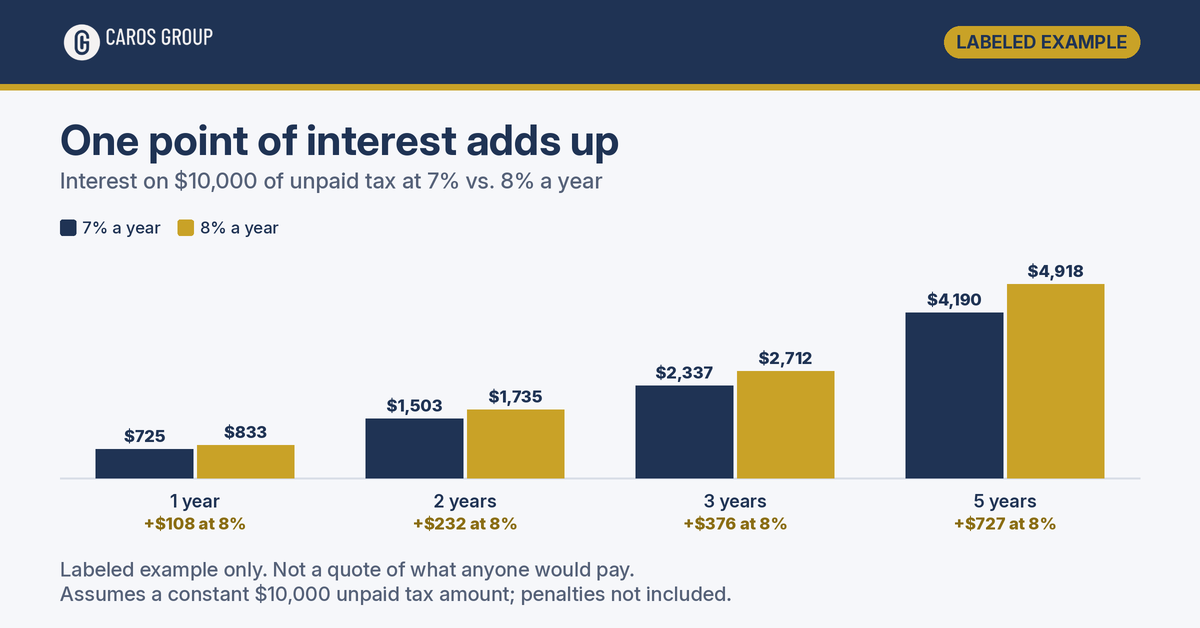
One point of interest adds up: $108 in year 1 and $727 in year 5 on $10,000 of unpaid tax, holding the rate constant. 8% is the underpayment rate for the first quarter of 2027; 7% was the rate for most of 2025 and 2026. Because the IRS resets the rate each quarter, holding a rate constant is an illustration.
See also the per-month late-payment penalty rates on payment plans.
Book a $99 20-minute call or call (256) 690-0213.
What “compounded daily” means
The IRS says the interest it charges and pays is compounded daily. That means interest is charged on the previous day's balance plus interest. Interest accrues on unpaid tax, penalties and interest until the balance is paid in full.
Example only, not a payoff amount. At 8% compounded daily, a $10,000 balance left unpaid for 365 days would add about $833 in interest, if the rate stayed at 8% all year. Simple interest at 8% would be $800. The IRS sets the rate each quarter, so it can change during the year, and penalties may also apply. When you pay, use the amount and the dates on your letter and your IRS account, not this example.
Paying later can cost more than paying sooner
The IRS says it is in your best interest to pay in full as soon as you can, to keep additional charges down. If you have an amount due and cannot pay it all, paying by the due date can reduce interest and penalty charges (IRS.gov, Understanding your IRS notice or letter).
Interest generally starts on the due date of the tax. An extension to file does not extend the date to pay. Paying the balance in full stops underpayment interest from adding up each day.
If tax is not paid by the original filing due date, the IRS says the balance is subject to interest and a monthly late payment penalty, and some penalty charges continue until the balance is paid in full (IRS.gov, Payment plans; installment agreements).
Interest and some penalties can keep adding during the collection period
The IRS generally has 10 years from the date a tax is assessed to collect that tax and any associated penalties and interest. That end date is called the Collection Statute Expiration Date, or CSED (IRS.gov, Time IRS can collect tax; Internal Revenue Code section 6502). An account can have more than one assessment, and each can have its own CSED.
Certain events can suspend or extend that period. IRS.gov lists examples: while the IRS reviews an installment agreement request or an offer in compromise, during a bankruptcy, during a collection due process hearing, after a request for innocent spouse relief, during certain military or combat zone service, and while you live outside the United States for 6 months or more in a row. So 10 years is the general rule, not a date to count on. The IRS shows the CSED on your account transcript. Facts and circumstances vary. Get a written review of your specific case.
During that time, interest and some penalties generally continue to accrue while the collection period is open. Some exceptions and limited relief may apply. Waiting for the collection period to end is not a plan. The IRS says it is in your best interest to pay in full as soon as you can, to keep additional charges down.
The IRS says it does not remove or reduce interest for reasonable cause or as first-time relief (IRS.gov, Interest). If a penalty is reduced or removed, the IRS automatically reduces or removes the related interest (IRS.gov, Penalty relief). In limited cases, the IRS may reduce interest caused by an unreasonable error or delay by an IRS officer or employee in a ministerial or managerial act, and only for the period of that error or delay, under Internal Revenue Code section 6404(e) (IRS.gov, Interest abatement). That is not the usual path.
If you have a balance or a letter, you can start with an IRS Situation Assessment ($599). Rush ($799) is the same Assessment, scheduled first. Questions first? Call (256) 690-0213.
Interest still adds up during an IRS payment plan
A payment plan, including an installment agreement, can give you more time to pay. It does not freeze the balance. Facts and circumstances vary. Get a written review of your specific case.
The IRS says that if you enter into an installment agreement, interest continues to accrue daily on any amount not paid, including on both penalties and interest. Setup fees can apply to some long-term plans. Interest and some penalty charges continue until the balance is paid in full.
An installment agreement may be only temporary relief. A payment plan is a way to pay over time. It is not the same as a plan for the rest of your tax and money situation.
If you are looking at a payment plan, you can start with an IRS Situation Assessment ($599). With your OK, a tax professional pulls your IRS records and sends written findings on the options that may fit, with the price of any next step in writing first. Rush ($799) is the same Assessment, scheduled first. See back taxes and payment plans and IRS Form 9465.
The balance on your IRS letter may not be the final payoff
An IRS letter that shows a balance is a snapshot. Interest can keep adding after the letter date until the balance is paid in full. Because interest is compounded daily, the payoff can differ by the time payment arrives.
The IRS says that if you received a notice, you will not be charged interest on the amount shown if you pay that amount in full on or before the “pay by” date on the notice. If the amount stays unpaid after that date, interest continues.
Start with the amount, the tax year or period, and the dates printed on your own letter. The CP or LTR number is in the right corner. You can look that code up from the IRS page Understanding your IRS notice or letter.
If you have one IRS letter and want written findings on what it is asking, see IRS Letter Review below.
If you overpaid, the IRS may pay interest too
For individuals, the overpayment rate for the first quarter of 2027 is also 8% per year, compounded daily. For corporations it is 7%, and 5.5% on the portion of a corporate overpayment above $10,000.
The IRS generally pays overpayment interest starting from the later of the return due date, the date a late return was received, the date the return is in a form the IRS can process, or the date the payment was made. Interest stops when the IRS refunds the overpayment or applies it to another balance.
There is an exception: the IRS has administrative time, typically 45 days, to issue a refund without paying interest on it. Not every overpayment earns interest.
If a letter is about a changed refund or a proposed change, start with the dates and figures on that letter.
Business owners and the 10% large-corporate rate
For the first quarter of 2027, the IRS rate for large corporate underpayments is 10%, up from 9% in the fourth quarter of 2026. The IRS quarterly interest rates page describes a large corporate underpayment as an underpayment of tax over $100,000 by a C-corporation.
Ordinary corporate underpayments use the 8% rate. Ordinary corporate overpayments use 7%, and 5.5% on the portion above $10,000.
If a business has an IRS balance or a letter, start with the IRS Situation Assessment or call (256) 690-0213.
How we can help
Caros Group provides online help for US taxpayers. We don't just represent clients, we help plan for the future.
A balance, several letters or a payment plan.
The IRS Situation Assessment is $599. With your OK, a tax professional pulls your IRS records and sends written findings on what is open, what is due when and the options that may fit. You see the price of any next step before that work starts. Rush ($799) is the same Assessment, scheduled first.
Start my Assessment: $599One IRS letter.
Upload your IRS letter and learn what it means before you respond.
An IRS Letter Review gives you written findings from a tax professional on what the letter is asking, the dates that matter, response options based on the letter and a recommended next step. Not IRS representation.
Written review in 1 to 3 business days.
Get My IRS Letter ReviewedQuestions first? Call (256) 690-0213.
Online help from Caros Group in Huntsville.
Caros Group is not affiliated with the IRS. Information on this page is general and is not legal, tax or financial advice.
Questions people ask
What is the IRS interest rate starting January 1, 2027?
For individuals, 8% per year, compounded daily, on underpayments and on overpayments, for the quarter beginning January 1, 2027 (IR-2026-144). The rate is set each quarter and can change later.
Does IRS interest compound daily?
Yes. The IRS says interest is compounded daily, which means it is charged on the previous day's balance plus interest, and it continues until the balance is paid in full.
Does interest still add up during an IRS payment plan?
Yes. If you enter into an installment agreement, interest continues to accrue daily on any amount not paid, including on both penalties and interest, until the balance is paid in full (IRS.gov, Interest and Payment plans). Facts and circumstances vary. Get a written review of your specific case.
Do interest and penalties keep adding during the collection period?
Interest and some penalties generally continue to accrue while the collection period is open. Some exceptions and limited relief may apply. The IRS generally has 10 years from the assessment date to collect the tax and associated penalties and interest (the CSED), and some events can suspend or extend that period. The IRS says it does not remove or reduce interest for reasonable cause or as first-time relief. Related interest is reduced if a penalty is reduced or removed, and interest abatement for an unreasonable IRS error or delay applies only in limited cases. Facts and circumstances vary. Get a written review of your specific case.
Is the balance on my IRS letter the amount I pay off?
Not always. The letter is a snapshot. Because interest is compounded daily, the payoff can differ by the time payment arrives. If you pay the amount shown in full on or before the "pay by" date, the IRS says you will not be charged interest on that amount. If it stays unpaid, interest continues.
Does the IRS pay interest if I overpaid?
Sometimes. For individuals, the overpayment rate for the first quarter of 2027 is 8% per year, compounded daily. The IRS also has a typical 45-day period to issue a refund without paying interest. Your facts control what applies.
What is the 10% large corporate rate?
For the first quarter of 2027, large corporate underpayments are charged 10%. The IRS quarterly interest rates page describes this as underpayments of tax over $100,000 by C-corporations.
How can I get help with a broader IRS balance or a payment plan?
Start with the IRS Situation Assessment ($599). Rush ($799) is the same Assessment, scheduled first. A tax professional reviews your IRS records, with your OK, and sends written findings. Or call (256) 690-0213.
How can I get a written review of one IRS letter?
Start with an IRS Letter Review. You get written findings from a tax professional on what the letter is asking, the dates that matter, response options based on the letter and a recommended next step. Not IRS representation. Written review in 1 to 3 business days. Or call (256) 690-0213.
How much does 1 point of interest cost on $10,000?
In this illustration, holding the rate constant, $108 in year one at 8% versus 7%, and $727 over five years. The IRS resets the rate each quarter, so holding a rate constant is an illustration.
How often does the IRS change the rate?
The IRS sets the underpayment rate every quarter.
Is the interest compounded?
Yes. The IRS says interest is compounded daily.
Does interest build on penalties?
Yes. Interest builds on unpaid tax, penalties and earlier interest until the balance is paid.
Sources
Read Nov. 24, 2026, on IRS.gov: