
File your taxes even if you can’t pay
Short answer: yes. File on time even if you cannot pay. The IRS charges a separate penalty for not filing, and it is higher per month than the penalty for paying late.
Or call (256) 690-0213.
The most common reason people file late is a balance due on the return. In a 2016 IRS research paper on people who filed late, about 30% gave that reason. If you are holding off because you cannot pay, you are in the biggest group.
The IRS says: “There’s also a penalty for failure to file a tax return, so you should file timely even if you can’t pay your balance in full.” The numbers below show why. Federal tax only.
What filing on time saves: a $10,000 example
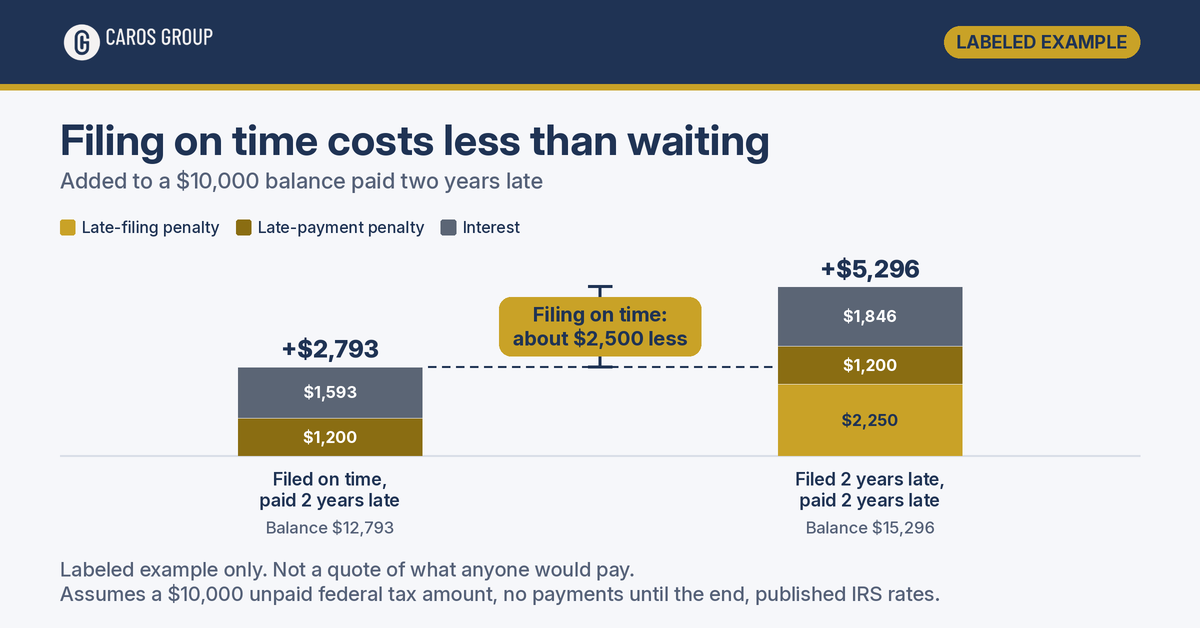
- Filed on time, paid two years late: $12,793.
- Not filed, then filed and paid two years late: $15,296.
- The difference is about $2,500. The late-filing penalty and the interest on it do not apply when the return is filed on time.
The late-filing penalty is 5% of the unpaid tax for each month or part of a month (4.5% net while the late-payment penalty also applies), up to 25%. The late-payment penalty is 0.5% a month, up to 25%. So each month a return is late costs more than each month a payment is late.
Assumptions. $10,000 of unpaid federal tax on a Form 1040 due April 15, 2025, no extension, no payments until the end, no penalty relief. Interest at the IRS underpayment rate each quarter. A first notice 45 days after the due date. Details are on IRS penalties and interest. Your numbers depend on your return, payments and dates.
What filing on time does not do
- It does not remove interest or the late-payment penalty. If you do not pay the tax by the original due date, interest and the monthly late-payment penalty apply to the unpaid amount.
- It does not bring a notice’s pay-by date back. If a notice arrives, review the pay-by date carefully. Interest and penalties can continue to accrue on an unpaid balance. See CP14.
What people usually do next
- File the return. Even if some information is missing and must be estimated in good faith, an on-time return avoids the late-filing penalty. If you are missing a form, ask for your IRS transcripts. If you have already missed the date, file as soon as you can. See unfiled tax returns.
- Pay what you can, when you can. Any payment reduces the amount interest and the late-payment penalty are figured on.
- Ask about a payment plan. The IRS says an individual may qualify to apply online for a long-term payment plan with $50,000 or less owed in combined tax, penalties and interest and all required returns filed, or a short-term plan (paying in 180 days or less) with less than $100,000 owed. Interest and penalties continue to build while a plan is in effect, and the late-payment penalty rate is reduced for someone who filed on time. See payment plans.
- Ask about penalty relief if it fits. The IRS has first-time penalty abatement, reasonable cause and statutory exceptions. You can ask. The IRS decides, and not having the money is generally not enough on its own.
How we help
On the 20-minute phone call, we listen, explain what your situation generally means, ask the questions that matter, and walk through options that may fit, such as an IRS payment plan. If an Assessment or further work makes sense, we quote it in writing first. If you decide to go further, a member of the Caros Group team can speak with the IRS for you once you sign the authorization form.
Book a $99 20-minute call or call (256) 690-0213.
Questions people ask
Should I file my taxes if I can’t pay?
Yes. The IRS says there is a penalty for not filing, so you should file on time even if you cannot pay your balance in full. In the example above, filing on time cost about $2,500 less over two years.
What happens if I file but don’t pay?
The tax is still due, plus interest and a late-payment penalty of 0.5% a month, up to 25%. You avoid the late-filing penalty of 5% a month. The IRS may send a notice with a pay-by date and the amount.
Is the penalty for filing late higher than the penalty for paying late?
Per month, yes: 5% for filing late (4.5% net while both apply) against 0.5% for paying late. Both are capped at 25%.
Can I get a payment plan if I can’t pay in full?
Often an individual can ask. The IRS says you may be able to apply online for a long-term plan if your combined tax, penalties and interest are $50,000 or less and you have filed all required returns, or a short-term plan if the total is less than $100,000. Interest and penalties continue to build while the plan is in effect.
Does an extension to file give me more time to pay?
For most people, no. The IRS says that if you do not pay the tax by the original filing due date, the balance is subject to interest and a monthly late-payment penalty. People who live outside the United States get an automatic 2-month extension to file and pay, and interest still runs from April 15.
What if I have already missed the filing date?
File as soon as you can. The late-filing penalty builds by month until it reaches 25%, so filing sooner means less builds up.
Want to talk it through? Book a $99 20-minute call or call (256) 690-0213.
Official sources
IRS.gov: payment plans, failure to file, failure to pay, penalty relief, interest; IRS Statistics of Income, Understanding the nonfiler/late filer.
Federal tax only. The example is not a quote.
Certified Financial Planner Board of Standards Center for Financial Planning, Inc. owns and licenses the certification marks CFP®, CERTIFIED FINANCIAL PLANNER®, and CFP® (with plaque design) in the United States to Certified Financial Planner Board of Standards, Inc., which authorizes individuals who successfully complete the organization’s initial and ongoing certification requirements to use the certification marks.